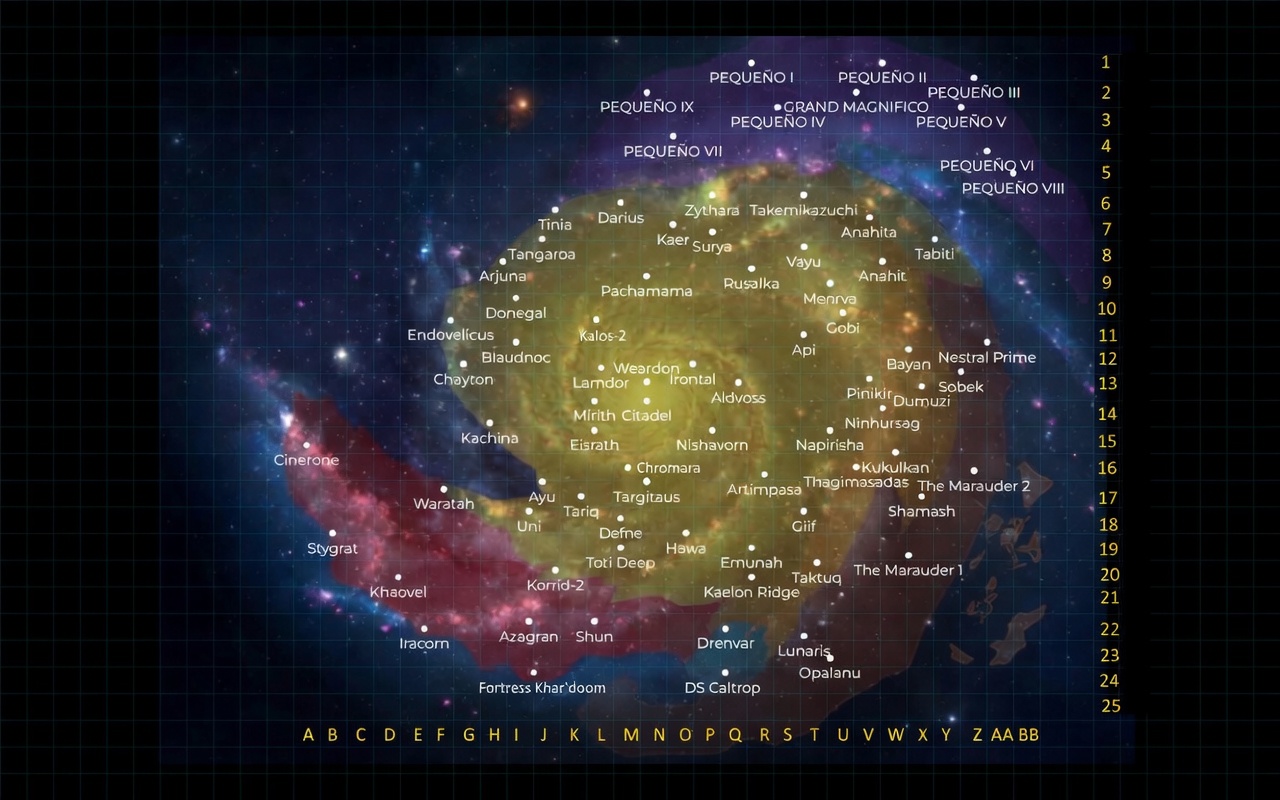
Aldvoss spans nearly every biome a single world can hold — glacial ranges, dense forest belts, and open plains, often within sight of one another.
Aldvoss represented the Council's geographic pillar from the outset, a single world standing in for the galaxy's full diversity of terrain and climate.
As one of the Founding Seven, Aldvoss retains Veto of Legacy authority — the power to overturn a majority council vote in matters touching the federation's foundational principles. A responsibility exercised rarely, and never lightly.
Aldvoss's open grassland supports a standard grain economy — Lavoka and Reeb both brewed here, though neither at premium grade.
Anahit is forested and lake-laced, its settlements built along shorelines rather than carved out of the woodland that still covers most of the surface.
Anahit joined the federation through the same path most member worlds did — recognizing the advantages of shared defense and unified trade over standing alone. It retains full internal autonomy and a vote equal to any of the other forty-nine worlds, founding or otherwise.
Anahit's open grassland supports a standard grain economy — Lavoka and Reeb both brewed here, though neither at premium grade. Anahit exports premium Cormine wood to Tangaroa and Ayu, where it's used for the aging barrels that give premium Carem its real character — the wood, not the recipe, is the actual secret behind the two islands' reputation.
Anahita is dry and unforgiving outside its handful of oasis settlements, each one a tightly built cluster of life around water that has never once run dry.
Anahita joined the federation through the same path most member worlds did — recognizing the advantages of shared defense and unified trade over standing alone. It retains full internal autonomy and a vote equal to any of the other forty-nine worlds, founding or otherwise.
Anahita's open grassland supports a standard grain economy — Lavoka and Reeb both brewed here, though neither at premium grade.
Api ran on accounts that officially didn't exist. Its banking infrastructure moved money into resistance cells across four sectors without ever putting a name to the transfers — the kind of financial architecture that keeps an insurgency breathing long after its weapons run dry.
Api was one of seven worlds vaporized in a single coordinated strike — three 480-lunarc Leashmetal-9 rods accelerated to 0.22c per target. Full event details are on file under D-7.
Arjuna's mountain ranges host a cluster of respected strategic and tactical academies, drawing students from across the federation despite the world's otherwise modest size.
Arjuna joined the federation through the same path most member worlds did — recognizing the advantages of shared defense and unified trade over standing alone. It retains full internal autonomy and a vote equal to any of the other forty-nine worlds, founding or otherwise.
Arjuna's open grassland supports a standard grain economy — Lavoka and Reeb both brewed here, though neither at premium grade.
Artimpasa is open grassland from horizon to horizon, its population spread thin across a steppe better suited to herding than dense settlement.
Artimpasa joined the federation through the same path most member worlds did — recognizing the advantages of shared defense and unified trade over standing alone. It retains full internal autonomy and a vote equal to any of the other forty-nine worlds, founding or otherwise.
Artimpasa's open grassland supports a standard grain economy — Lavoka and Reeb both brewed here, though neither at premium grade.
Ayu is mostly ocean, its land limited to a handful of low islands strung above one of the most extensive coral reef networks on record.
Ayu joined the federation through the same path most member worlds did — recognizing the advantages of shared defense and unified trade over standing alone. It retains full internal autonomy and a vote equal to any of the other forty-nine worlds, founding or otherwise.
Ayu's open grassland supports a standard grain economy — Lavoka and Reeb both brewed here, though neither at premium grade. Ayu is one of two worlds producing premium-tier Carem, prized above the standard grade produced across the other island worlds.
Azagran is windswept plains under a permanent overcast, broken only by garrison lines. Whatever existed here before annexation left no record worth keeping. The Dominion does not administer for character — it administers for compliance, and Azagran complies.
Azagran's open grassland supports a standard grain economy — Lavoka and Reeb both brewed here, though neither at premium grade.
Bayan's rolling hills are given over almost entirely to pasture, a quiet, prosperous world that has never needed to be anything louder than comfortable.
Bayan joined the federation through the same path most member worlds did — recognizing the advantages of shared defense and unified trade over standing alone. It retains full internal autonomy and a vote equal to any of the other forty-nine worlds, founding or otherwise.
Bayan's open grassland supports a standard grain economy — Lavoka and Reeb both brewed here, though neither at premium grade.
Blaudnoc was the rebellion's last standing military academy, training the officers and tacticians who would have led the next generation of resistance command. Its destruction wasn't about territory. It was about making sure that generation never graduated.
Blaudnoc was one of seven worlds vaporized in a single coordinated strike — three 480-lunarc Leashmetal-9 rods accelerated to 0.22c per target. Full event details are on file under D-7.
Chayton is wide-open prairie under an unusually clear sky, its settlements spaced far enough apart that most residents can see the horizon from their own front door.
Chayton joined the federation through the same path most member worlds did — recognizing the advantages of shared defense and unified trade over standing alone. It retains full internal autonomy and a vote equal to any of the other forty-nine worlds, founding or otherwise.
Chayton's open grassland supports a standard grain economy — Lavoka and Reeb both brewed here, though neither at premium grade.
Hildaplumps are native to Chayton's open prairie, kept widely as companions for their calm temperament.
▸ VIEW SPECIES PROFILE: HILDAPLUMP
Two stripped asteroids still hang in Chromara's orbit, their mining husks visible from the surface on a clear night — quiet monuments to the wealth that once flowed out of them and across an entire federation. The world below has aged past its golden age into something quieter: a capital with nothing left to govern.
Thairot Rendell never conquered his way to power. He mined two asteroids orbiting his homeworld and bought it instead, trading prosperity for loyalty across a federation that, for a time, wanted for nothing. The species that bears his world's name — Chromar — still traces its identity back to Chromara, regardless of what became of the empire it once anchored.
▸ VIEW SPECIES PROFILE: CHROMAR
Chromara endures as an ordinary world among many now, its political significance gone along with the asteroids that funded it. Its place in galactic history was secured not by what it became, but by what it once was.
Cinerone is an ash-covered volcanic remnant, its old craters long since cold. Whatever existed here before annexation left no record worth keeping. The Dominion does not administer for character — it administers for compliance, and Cinerone complies.
Cinerone produces standard-tier Vay, like most volcanic worlds.
The Citadel is built like what it is — a fortress, not a palace. Heavy, armored, anchored in open space rather than orbit around any single member world. The design is deliberate. No founding world, no peak-tier member, gets to claim the seat of galactic governance as its own backyard, and nothing about its construction suggests it was built for comfort over duty.
Serves as the primary coordinating point for interstellar diplomacy, regulatory alignment, and cooperative development across all fifty member worlds. Trade frameworks, dispute resolution, and shared policy enforcement are all conducted from within its halls, while individual worlds retain internal autonomy.
When a member of the Founding Seven invokes the Veto of Legacy, it is exercised in the Citadel's central chamber — the same room where the original Treaty of the Seven Worlds is still kept on permanent display.
Darius is a working world of open farmland, its temperate plains given almost entirely over to agriculture that feeds well beyond its own borders.
Darius joined the federation through the same path most member worlds did — recognizing the advantages of shared defense and unified trade over standing alone. It retains full internal autonomy and a vote equal to any of the other forty-nine worlds, founding or otherwise.
Darius's open grassland supports a standard grain economy — Lavoka and Reeb both brewed here, though neither at premium grade.
Defne sits along a warm coastline, terraced towns climbing the hills above harbor towns that have traded in the same goods for generations.
Defne joined the federation through the same path most member worlds did — recognizing the advantages of shared defense and unified trade over standing alone. It retains full internal autonomy and a vote equal to any of the other forty-nine worlds, founding or otherwise.
Defne's open grassland supports a standard grain economy — Lavoka and Reeb both brewed here, though neither at premium grade. Defne produces standard-tier Carem.
Donegal is rugged and wind-scoured, its highlands wrapped in coastal mist for most of the year — a world more comfortable with weather than with crowds.
Donegal joined the federation through the same path most member worlds did — recognizing the advantages of shared defense and unified trade over standing alone. It retains full internal autonomy and a vote equal to any of the other forty-nine worlds, founding or otherwise.
Donegal is one of only two worlds producing premium-tier Lavoka, its coastal highland mist giving the spirit a distinct character. Donegal's grasslands also feed a standard Reeb brewing trade. Donegal produces standard-tier Carem.
Drenvar runs hot and dry, red volcanic stone underfoot in nearly every district. It's an unforgiving world to live on by choice rather than necessity — which made its decision to sign the Accords early all the more notable. This wasn't a world that needed saving. It was a world that saw what was coming.
Despite the harsh terrain, Drenvar households commonly keep Nurls and Taamis as companions, both common across CSC-aligned worlds.
When Nico Altaris drafted the Caltrop Accords, the Galaxian High Council still functioned as the established governing body — joining CSC was a calculated bet, not a last resort. Drenvar made that bet first, formally recognizing Caltrop Space Command as its official military and security force while every other world still had the luxury of waiting.
The relationship deepened over time. Caltrop Space Command now stands as Drenvar's official law enforcement, not merely its recognized military partner — a distinction with real teeth. Sylvexaria "Vexa" Thalassa currently holds the position of Head of Law Enforcement for Drenvar, putting CSC's own command structure directly in charge of policing the world that bet on them first.
Zeraphinia is Drenvar's largest city — brass towers and cobblestone streets — and the place where both Nico Altaris and Kade Flint were born, in its lower districts, under Dominion control. Everything that followed — the partnership, the heist that cost Flint his freedom, the founding of CSC itself — traces back to streets that no longer answer to the Dominion at all.
Drenvar's railcar system traces back to a single prototype tested in Zeraphinia — the first of its kind anywhere. What it became afterward, and what happened the day it's remembered for, remains under archive review.
Drenvar is home to Vermora, a low, thick-leaved plant with deep red-black waxy foliage that stores groundwater and reflects heat, rooted deep into cracks in volcanic stone. It grows sparse and stunted near Zeraphinia's dry belt, but fuller and more vividly red near the planet's geothermal-fed regions.
Drenvar's volcanic terrain is also home to Canic Stelio — a tough, wild lizard species commonly shortened to "Canics." They feed on Vermora, which makes them a persistent pest for legitimate growers.
Rather than exterminate them outright, growers tacitly allow traffickers to plant separate decoy Vermora fields purely to lure Canics away from the real crop. The traffickers farm the lured Canics for a glandular secretion — a black-market drug and aphrodisiac concentrated from the Vermora compounds the animals accumulate from their diet. The drug shares its name with the animal it comes from: Canic.
Drenvar has two exports tied to its geothermal-fed regions: a crystallized mineral drawn from the volcanic soil, and Vermora Vay ("Vee-Vay") — the premium tier of Vay, drawn from the Vermora plant itself, above the everyday Vay served galaxy-wide.
Vermora City, Drenvar's geothermal-region settlement, is where Vermora grows fullest and reddest — and where Vermora Vay production is centered.
At the core sits the central spire — formed around the docking position of the Phantom Cat XT prototype — currently berthed at the core, though capable of disengaging at any time. From the spire, long spine arms radiate outward in every direction, each one ending in docking tips where ships connect and disengage.
TransitTubes run along the exterior of the spine arms, exposed to space, carrying crew between the docking tips and the central spire's main bay. Fast, functional, no frills.
The Caltrop orbits the Hedron Star alongside the Aetherpaloo Forge. A phase gate connects the two structures — instantaneous transit between them.
A vast, dimly lit chamber stretching deep into the station's frame. No windows. No natural light. Rows of massive cylindrical tanks filled with thick, slow-moving luminescent fluid that glows faint blue. Dense clusters of dark non-metallic modules submerged inside, connected by conduits that pulse with soft light. The hum comes from everywhere and nowhere at once.
This is not High Performance Computing. The tanks are not cooling units. The tanks are the system. Information is processed using pulses of light rather than electricity. The luminescent fluid slows and traps those pulses, enabling both processing and memory within the same medium.
Specialized arrays mounted on the Caltrop's exterior hull capture raw photonic energy directly from the Hedron Star and channel it to the 16th floor. The station runs on starlight. The entire farm exists for one purpose — Kernel.
Dumuzi's surface is dominated by a single vast river system, its floodplains supporting dense agricultural settlements that have never needed to spread far from the water.
Dumuzi joined the federation through the same path most member worlds did — recognizing the advantages of shared defense and unified trade over standing alone. It retains full internal autonomy and a vote equal to any of the other forty-nine worlds, founding or otherwise.
Dumuzi's open grassland supports a standard grain economy — Lavoka and Reeb both brewed here, though neither at premium grade.
Eisrath is a cold, glacial world, its cities built into ice shelves and warmed by deep geothermal taps rather than fighting the climate directly.
Eisrath's extremes rounded out the Council's geographic pillar, proof that founding status was never reserved for the most hospitable worlds — only the most committed.
As one of the Founding Seven, Eisrath retains Veto of Legacy authority — the power to overturn a majority council vote in matters touching the federation's foundational principles. A responsibility exercised rarely, and never lightly.
Emunah's coastline is dominated by tall cliffs, its towns perched along the edges with narrow switchback roads leading down to the harbors below.
Emunah joined the federation through the same path most member worlds did — recognizing the advantages of shared defense and unified trade over standing alone. It retains full internal autonomy and a vote equal to any of the other forty-nine worlds, founding or otherwise.
Emunah's open grassland supports a standard grain economy — Lavoka and Reeb both brewed here, though neither at premium grade. Emunah produces standard-tier Carem.
Endovelicus is known for its natural thermal springs, settlements built around mineral-rich pools that draw visitors from neighboring systems as much as residents.
Endovelicus joined the federation through the same path most member worlds did — recognizing the advantages of shared defense and unified trade over standing alone. It retains full internal autonomy and a vote equal to any of the other forty-nine worlds, founding or otherwise.
Endovelicus's open grassland supports a standard grain economy — Lavoka and Reeb both brewed here, though neither at premium grade.
Four combatants — Vexa, Nico, Flint, and Ramona — beat Grimgor Slaughter to the floor. Vexa checked his pulse. Declared him down. They kept hitting him anyway. For five more seconds. Ten. Fifteen.
He pushed back up. As they reached the phase gate, Grimgor stood in the corridor behind them — bloodied, armor cracked, face twisted — still reaching. The gate sealed. He was still standing.
Giif was infrastructure more than population — a world built around the relays, encryption banks, and communication networks that let the resistance coordinate across distances no single fleet could cover. Every encrypted message that ever reached a CSC ship passed through hardware that no longer exists.
Giif was one of seven worlds vaporized in a single coordinated strike — three 480-lunarc Leashmetal-9 rods accelerated to 0.22c per target. Full event details are on file under D-7.
Gobi is dry, open steppe with settlements spaced far apart, a world built around water access more than anything else.
Gobi joined the federation through the same path most member worlds did — recognizing the advantages of shared defense and unified trade over standing alone. It retains full internal autonomy and a vote equal to any of the other forty-nine worlds, founding or otherwise.
Gobi's open grassland supports a standard grain economy — Lavoka and Reeb both brewed here, though neither at premium grade.
Grand Magnifico is divided into four continents, each the absolute domain of a single royal family. A council exists in name, but power here has never been shared — none of the four have ever felt a need to ask permission of the others.
No one ruled by the Society lives on Grand Magnifico itself. Every laborer, every miner, every person born under Exalted rule lives on one of nine subjugated worlds — uniform in structure, identical in purpose, separated only by a number.
The Exalted do not write in lowercase. A diminished letterform is read as a diminished self — and nothing permitted to stand on Grand Magnifico is allowed to appear diminished. The rule holds on every continent, in every court, on every official record the Society produces.
The Society sells MAGNIFICO VAY ("MagVay"), an engineered, mass-produced answer to Drenvar's Vermora Vay, boasted as superior by the four royal families. They also sell a premium CAREM, made by kidnapping premium Carem makers from Tangaroa and Ayu and forcing them to perfect the Exalted Ones' own version — marketed as great, but missing the one ingredient that actually matters: genuine Cormine barrel wood from Anahit.
Hawa's tropical lowlands run straight to the coast with little in between, its population concentrated in a handful of port towns.
Hawa joined the federation through the same path most member worlds did — recognizing the advantages of shared defense and unified trade over standing alone. It retains full internal autonomy and a vote equal to any of the other forty-nine worlds, founding or otherwise.
Hawa's open grassland supports a standard grain economy — Lavoka and Reeb both brewed here, though neither at premium grade. Hawa produces standard-tier Carem.
What is known: Iracorn is the origin point and seat of power of the Ebon Dominion. It is where Conlor Ba'ash built what he built. Beyond that, the archive has nothing. No operative has returned with confirmed intelligence from inside its borders.
If you're reading this and you have more — the archive is waiting.
Irontal's surface is ridged with exposed ore seams and open-pit mining operations, its highlands stripped and rebuilt across generations of continuous extraction.
Where Lamdor builds, Irontal supplies. Its ore reserves fed the Council's industrial pillar from the very first treaty, and still do.
As one of the Founding Seven, Irontal retains Veto of Legacy authority — the power to overturn a majority council vote in matters touching the federation's foundational principles. A responsibility exercised rarely, and never lightly.
The Helolorian are native to Irontal, closely tied to its mining and fabrication economy.
▸ VIEW SPECIES PROFILE: HELOLORIAN
Kalos-2's civilian settlements look like any other modest GHC world from a distance. It's the work camp dominating one hemisphere that tells the real story — rows of labor blocks and processing yards built to Dominion specification, not Council standard.
The Dominion sends its prisoners to Kalos-2 — a practice that should, on paper, require approval from the very council whose authority the Dominion still nominally answers to. It has never been formally challenged. By the time anyone with the standing to object noticed the pattern, the Dominion had enough influence within the council to make the question irrelevant.
Kalos-2 still holds its seat and its vote like any other member world. What it doesn't hold is the camp on its own surface — a quiet preview of exactly how the Dominion would eventually take the rest of the council apart: not by force, but by being allowed to operate from the inside until objecting no longer mattered.
Kachina's settlements are built into canyon walls across its arid highlands, taking advantage of natural shade and shelter rather than fighting the terrain.
Kachina joined the federation through the same path most member worlds did — recognizing the advantages of shared defense and unified trade over standing alone. It retains full internal autonomy and a vote equal to any of the other forty-nine worlds, founding or otherwise.
Kachina's open grassland supports a standard grain economy — Lavoka and Reeb both brewed here, though neither at premium grade.
Kaelon Ridge wasn't a homeworld to anyone who lived there. It was a refuge — 1.2 billion people displaced from seventeen worlds the Dominion had already taken, rebuilding lives and, increasingly, resistance cells inside the camps. Safety in numbers turned out to be exactly the wrong assumption.
Kaelon Ridge was one of seven worlds vaporized in a single coordinated strike — three 480-lunarc Leashmetal-9 rods accelerated to 0.22c per target. Full event details are on file under D-7.
Kaer's surface is cut into long terraces climbing every hillside, settlements stepping upward in tiers rather than spreading outward.
Kaer joined the federation through the same path most member worlds did — recognizing the advantages of shared defense and unified trade over standing alone. It retains full internal autonomy and a vote equal to any of the other forty-nine worlds, founding or otherwise.
Kaer's open grassland supports a standard grain economy — Lavoka and Reeb both brewed here, though neither at premium grade.
Khaovel is temperate enough to be livable, which is precisely why the garrison here is heavier than most. Whatever existed here before annexation left no record worth keeping. The Dominion does not administer for character — it administers for compliance, and Khaovel complies.
Korrid-2 is built into and around its own canyon system, a city with no shortage of places to hide and even fewer places to be found if something — or someone — would rather you weren't. It's Raze's homeworld, and the only law that has ever consistently held here is whatever he decides it is.
BodyDitch 142 is built into Korrid-2's surface to Raze's own specifications — cells, interrogation rooms, and corridors engineered specifically to maximize disorientation and minimize any possibility of rescue. The name means nothing to outsiders. To anyone who's heard what happens inside it, the name means everything.
Ramona Driftsong was abducted here before later turning up in Dominion custody at Fortress Khar'doom alongside Kade Flint. Whether Korrid-2 was the destination or simply the point of capture remains unclear — full chain of custody is cross-referenced under her own file.
Korrid-2 is home to BodyDitch 142, a facility Raze designed and built himself, to his own specifications. Raze controls it and commands the Crimson Marauders under the authority of Ras Varkis.
Kukulkan is dense tropical jungle dotted with the ruins of a much older civilization, settlements built carefully around structures nobody quite remembers the original purpose of.
Kukulkan joined the federation through the same path most member worlds did — recognizing the advantages of shared defense and unified trade over standing alone. It retains full internal autonomy and a vote equal to any of the other forty-nine worlds, founding or otherwise.
Kukulkan's open grassland supports a standard grain economy — Lavoka and Reeb both brewed here, though neither at premium grade.
Lamdor was a world of forges and fabrication yards, one of the Founding Seven that signed the original Treaty of the Seven Worlds and carried Veto of Legacy authority into the Galaxian High Council. It held the only vote standing between Ba'ash and the council's dissolution — until it didn't.
Lamdor was one of seven worlds vaporized in a single coordinated strike — three 480-lunarc Leashmetal-9 rods accelerated to 0.22c per target. Full event details are on file under D-7.
Lunaris is silver and blue from orbit to street level — elegant spires rising against a permanently cool-lit evening sky, every facade polished to a mirror finish. The entertainment district never goes dark, drifting hover traffic and clean architectural lines giving the whole world a sense of restrained, expensive calm even at its most crowded.
The gambling dens are Lunaris's real architecture — marble floors, holo chandeliers, synth ale flowing under permanent haze. Poker tables anchor most rooms, but anything with odds attached will find a table somewhere on this world. Reputations are built hand by hand here. The forgettable players last longest.
Cards and chance are Lunaris's trade. Blood is Drenvar's. The two worlds have never competed for the same wager, and neither shows any sign of wanting to start.
Armed robbery of high-traffic dens is not unheard of, met when it happens by a fast Dominion enforcement response in the system. Polished surfaces don't make Lunaris safe. They make it worth robbing.
Menrva is mostly city — a single sprawling urban network spread across temperate plains, with little open land left between one district and the next.
Menrva joined the federation through the same path most member worlds did — recognizing the advantages of shared defense and unified trade over standing alone. It retains full internal autonomy and a vote equal to any of the other forty-nine worlds, founding or otherwise.
Menrva's open grassland supports a standard grain economy — Lavoka and Reeb both brewed here, though neither at premium grade.
Mirith is built around its observatories and research campuses, terraced into hillsides so that nothing blocks the sightlines to the sky above.
Mirith carried the Council's scientific pillar, its observatories among the first instruments to track the early movements of what would later be identified as Ebon Dominion kinetic rods.
As one of the Founding Seven, Mirith retains Veto of Legacy authority — the power to overturn a majority council vote in matters touching the federation's foundational principles. A responsibility exercised rarely, and never lightly.
Napirisha's population clusters along a wide river delta, its wetland settlements built on stilts and connected by a constant traffic of small boats.
Napirisha joined the federation through the same path most member worlds did — recognizing the advantages of shared defense and unified trade over standing alone. It retains full internal autonomy and a vote equal to any of the other forty-nine worlds, founding or otherwise.
Napirisha's open grassland supports a standard grain economy — Lavoka and Reeb both brewed here, though neither at premium grade.
Napirisha is home to New Celeria, a city built around the Celerian Clam Flats — the source of the clams Nico cooked for Dr. Rauch.
Nestral Prime ran on its factories, turning out small arms and plasma rifles for a resistance that had nowhere else reliable to source them. It wasn't the biggest manufacturing world in the galaxy. It was simply the one supplying people Ba'ash needed unarmed.
Nestral Prime was one of seven worlds vaporized in a single coordinated strike — three 480-lunarc Leashmetal-9 rods accelerated to 0.22c per target. Full event details are on file under D-7.
Ninhursag's volcanic soil makes it some of the most productive farmland in its region, despite — or because of — the occasional minor tremor.
Ninhursag joined the federation through the same path most member worlds did — recognizing the advantages of shared defense and unified trade over standing alone. It retains full internal autonomy and a vote equal to any of the other forty-nine worlds, founding or otherwise.
Ninhursag's open grassland supports a standard grain economy — Lavoka and Reeb both brewed here, though neither at premium grade. Ninhursag produces standard-tier Vay, like most volcanic worlds.
Nishavorn is the Council's cultural face — galleries, amphitheaters, and diplomatic quarters built to host delegations from every member world without favoring any one of them.
Nishavorn carried the Council's cultural pillar, and still hosts more inter-world ceremony and diplomacy than any other founding world.
As one of the Founding Seven, Nishavorn retains Veto of Legacy authority — the power to overturn a majority council vote in matters touching the federation's foundational principles. A responsibility exercised rarely, and never lightly.
Opalanu shares Lunaris's silver and blue palette but none of its restraint. Palatial estates spill into private lagoons, banquet halls run without closing hours, and every structure on the surface was designed to outdo whatever came before it. Subtlety was never part of the architecture.
Lunaris sells a game — odds, skill, the thrill of a calculated risk. Opalanu sells none of that structure. There is no hand to read, no tell to hide. Whatever a visitor wants, in whatever quantity, is simply provided. The only currency that matters is how much someone is willing to spend.
Opalanu draws visitors who would never be caught in the same room back home — nobility, off-duty officials, anyone with enough wealth to buy discretion along with everything else. The world's reputation is exactly what its visitors want it to be: unverifiable.
Pachamama's mountainsides are carved into agricultural terraces from base to peak, a world that has turned nearly all of its difficult terrain into farmland.
Pachamama joined the federation through the same path most member worlds did — recognizing the advantages of shared defense and unified trade over standing alone. It retains full internal autonomy and a vote equal to any of the other forty-nine worlds, founding or otherwise.
Pachamama's open grassland supports a standard grain economy — Lavoka and Reeb both brewed here, though neither at premium grade.
The surface here is a volcanic landscape, vents and ash fields stretching to every horizon. The extraction process — geothermal extraction — runs day and night across every district. Standardized housing blocks rise beside the extraction towers, identical in design to the housing on every other Pequeño world, a structure imposed rather than chosen. There is no window on this world without a refinery in view.
The surface here is frozen tundra, flat and white as far as instruments can read. The extraction process — sub-surface boring rigs — runs day and night across every district. Standardized housing blocks rise beside the extraction towers, identical in design to the housing on every other Pequeño world, a structure imposed rather than chosen. There is no window on this world without a refinery in view.
The surface here is arid desert, cracked and wind-scoured. The extraction process — atmospheric processing towers — runs day and night across every district. Standardized housing blocks rise beside the extraction towers, identical in design to the housing on every other Pequeño world, a structure imposed rather than chosen. There is no window on this world without a refinery in view.
The surface here is dense jungle-swamp, cleared in widening rings around each facility. The extraction process — canopy-cleared excavation — runs day and night across every district. Standardized housing blocks rise beside the extraction towers, identical in design to the housing on every other Pequeño world, a structure imposed rather than chosen. There is no window on this world without a refinery in view.
The surface here is barren rock under a near-vacuum sky. The extraction process — sealed colony domes — runs day and night across every district. Standardized housing blocks rise beside the extraction towers, identical in design to the housing on every other Pequeño world, a structure imposed rather than chosen. There is no window on this world without a refinery in view.
The surface here is a storm-wracked surface, lit constantly by lightning overhead. The extraction process — electrical-storm powered refineries — runs day and night across every district. Standardized housing blocks rise beside the extraction towers, identical in design to the housing on every other Pequeño world, a structure imposed rather than chosen. There is no window on this world without a refinery in view.
The surface here is vast saline flats, white and cracked under a flat horizon. The extraction process — brine-extraction byproduct processing — runs day and night across every district. Standardized housing blocks rise beside the extraction towers, identical in design to the housing on every other Pequeño world, a structure imposed rather than chosen. There is no window on this world without a refinery in view.
The surface here is an entirely subterranean colony carved from rock. The extraction process — tunnel-bored cavern networks — runs day and night across every district. Standardized housing blocks rise beside the extraction towers, identical in design to the housing on every other Pequeño world, a structure imposed rather than chosen. There is no window on this world without a refinery in view.
The surface here is an oceanic archipelago, scattered islands over a deep seabed. The extraction process — seabed dredging operations — runs day and night across every district. Standardized housing blocks rise beside the extraction towers, identical in design to the housing on every other Pequeño world, a structure imposed rather than chosen. There is no window on this world without a refinery in view.
Pinikir is a high, wind-swept plateau, dry and thinly populated, its settlements built low against the constant wind rather than tall.
Pinikir joined the federation through the same path most member worlds did — recognizing the advantages of shared defense and unified trade over standing alone. It retains full internal autonomy and a vote equal to any of the other forty-nine worlds, founding or otherwise.
Pinikir's open grassland supports a standard grain economy — Lavoka and Reeb both brewed here, though neither at premium grade.
Rusalka's lowlands are scattered with thousands of small lakes, its towns built along the shorelines rather than competing for the limited dry ground between them.
Rusalka joined the federation through the same path most member worlds did — recognizing the advantages of shared defense and unified trade over standing alone. It retains full internal autonomy and a vote equal to any of the other forty-nine worlds, founding or otherwise.
Rusalka's open grassland supports a standard grain economy — Lavoka and Reeb both brewed here, though neither at premium grade.
Shamash's desert basin hosts some of the largest solar collection arrays in its region, a world that turned its harshest feature into its most reliable export.
Shamash joined the federation through the same path most member worlds did — recognizing the advantages of shared defense and unified trade over standing alone. It retains full internal autonomy and a vote equal to any of the other forty-nine worlds, founding or otherwise.
Shun is sparse and isolated, the kind of place that earns its name by being easy to forget. Whatever existed here before annexation left no record worth keeping. The Dominion does not administer for character — it administers for compliance, and Shun complies.
Sobek's surface is dominated by wide tropical wetlands and slow-moving rivers, its settlements built on raised ground above the seasonal floodplain.
Sobek joined the federation through the same path most member worlds did — recognizing the advantages of shared defense and unified trade over standing alone. It retains full internal autonomy and a vote equal to any of the other forty-nine worlds, founding or otherwise.
Sobek's open grassland supports a standard grain economy — Lavoka and Reeb both brewed here, though neither at premium grade.
Stygrat is a grey rock wasteland, scoured flat by centuries of wind and ash. Whatever existed here before annexation left no record worth keeping. The Dominion does not administer for character — it administers for compliance, and Stygrat complies.
The Brontar are native to Stygrat, most widely known through their presence in arena and underground combat circuits.
▸ VIEW SPECIES PROFILE: BRONTAR
Takemikazuchi's coastlines see near-constant storm activity, its towns built with reinforced architecture as a matter of routine rather than emergency.
Takemikazuchi joined the federation through the same path most member worlds did — recognizing the advantages of shared defense and unified trade over standing alone. It retains full internal autonomy and a vote equal to any of the other forty-nine worlds, founding or otherwise.
Takemikazuchi's open grassland supports a standard grain economy — Lavoka and Reeb both brewed here, though neither at premium grade. Takemikazuchi produces standard-tier Carem.
Tangaroa is a world of scattered island chains over open ocean, its communities more connected by boat traffic than any road network.
Tangaroa joined the federation through the same path most member worlds did — recognizing the advantages of shared defense and unified trade over standing alone. It retains full internal autonomy and a vote equal to any of the other forty-nine worlds, founding or otherwise.
Tangaroa's open grassland supports a standard grain economy — Lavoka and Reeb both brewed here, though neither at premium grade. Tangaroa is one of two worlds producing premium-tier Carem, prized above the standard grade produced across the other island worlds.
The Ga'roa are native to Tangaroa's deep coastal waters, though sightings above the shallows remain rare. Most existing accounts come secondhand from coastal trading communities.
▸ VIEW SPECIES PROFILE: GA'ROA
Targitaus is wide steppe country, much of its population still organized around herding routes that haven't changed in generations.
Targitaus joined the federation through the same path most member worlds did — recognizing the advantages of shared defense and unified trade over standing alone. It retains full internal autonomy and a vote equal to any of the other forty-nine worlds, founding or otherwise.
Targitaus's open grassland supports a standard grain economy — Lavoka and Reeb both brewed here, though neither at premium grade.
Tariq's economy runs through its coastal trade ports, a temperate world where most settlements grew up around harbors rather than inland.
Tariq's seat belonged to Chairman Hargrave for thirty drens of what looked, from the outside, like ordinary public service. He was removed at Ba'ash's order. Cainen Martra now holds the seat in his place — installed, not elected, and answering to a different chain of command than the one Tariq's own people put in office.
Further intelligence on Hargrave's tenure is cross-referenced under his own file.
Tariq's open grassland supports a standard grain economy — Lavoka and Reeb both brewed here, though neither at premium grade. Tariq produces standard-tier Carem.
Thagimasadas is cold and forested at altitude, its settlements tucked into highland valleys that stay sheltered from the worst of the weather above the treeline.
Thagimasadas joined the federation through the same path most member worlds did — recognizing the advantages of shared defense and unified trade over standing alone. It retains full internal autonomy and a vote equal to any of the other forty-nine worlds, founding or otherwise.
Thagimasadas is one of only two worlds producing premium-tier Lavoka, its cold-climate highland forests giving the spirit a distinct character. Thagimasadas's grasslands also feed a standard Reeb brewing trade.
The Marauder 1 belongs to no planet. It drifts on its own gravitational path, untethered to any system worth charting — the kind of body most navigational records don't bother to log, since orphaned moons rarely matter to anyone. That obscurity is the entire point.
The Crimson Marauders operate as the Dominion's criminal enforcement arm — the violence the Dominion would rather not put its own uniform on. The Marauder 1 functions as their primary staging ground: larger than its twin, better supplied, and the first stop for anything moving through Marauder hands before it goes wherever it's actually headed.
The Marauder 2 shares its twin's defining trait — no parent world, no gravitational anchor, no reason for a standard chart to ever flag it. Where The Marauder 1 sees regular traffic, this one stays deliberately quiet.
If The Marauder 1 is where business happens, The Marauder 2 is where the evidence of it goes to sit. Stolen cargo, weapons that need to disappear for a while, anything too hot to keep moving — it gets stashed here until the Crimson Marauders decide it's safe to bring back into circulation.
Tinia's population follows its river valleys, dense agricultural settlement hugging the waterways that cut through otherwise unremarkable plains.
Tinia joined the federation through the same path most member worlds did — recognizing the advantages of shared defense and unified trade over standing alone. It retains full internal autonomy and a vote equal to any of the other forty-nine worlds, founding or otherwise.
Tinia's open grassland supports a standard grain economy — Lavoka and Reeb both brewed here, though neither at premium grade.
Toti Deep is almost entirely ocean, its few settlements built into pressurized trench habitats rather than on the scattered surface islands above.
Toti Deep's seat went empty for the vote that mattered most — its entire delegation killed in the lead-up, with no claimed responsibility and no formal investigation that ever reached a conclusion. The council proceeded without them, which is precisely what a delegation's removal, timed correctly, is meant to accomplish.
Whether the killing was random, retaliatory, or surgical remains an open question on this end of the archive. The timing has never read as a coincidence to anyone who's looked closely.
Toti Deep retains its seat and its vote on paper, same as any other member world. In practice, it has gone unrepresented at the one moment representation would have counted for something.
Toti Deep produces standard-tier Carem.
Uni is unusual for having only a single continent, its temperate plains supporting one continuous stretch of settlement rather than the scattered geography most worlds have.
Uni joined the federation through the same path most member worlds did — recognizing the advantages of shared defense and unified trade over standing alone. It retains full internal autonomy and a vote equal to any of the other forty-nine worlds, founding or otherwise.
Uni's open grassland supports a standard grain economy — Lavoka and Reeb both brewed here, though neither at premium grade.
Waratah's surface is covered in dense, flowering scrubland — a deceptively gentle landscape for a world that answers entirely to the Dominion. Whatever existed here before annexation left no record worth keeping. The Dominion does not administer for character. It administers for compliance, and Waratah complies.
Waratah's open grassland supports a standard grain economy — Lavoka and Reeb both brewed here, though neither at premium grade.
Weardon's surface is dense with laboratory districts and testing fields, a working partner to Mirith's theoretical observatories.
Where Mirith theorizes, Weardon applies. Together the two worlds carried the Council's scientific pillar from treaty to High Council without interruption.
As one of the Founding Seven, Weardon retains Veto of Legacy authority — the power to overturn a majority council vote in matters touching the federation's foundational principles. A responsibility exercised rarely, and never lightly.
Zythara was the only world the Zytharan species ever called home — a scaled, lean-built people known for disciplined combat training and an unusually controlled emotional bearing even under pressure. The civilization there was old, stable, and by every account proud of what it had built.
Other worlds destroyed in D-7 lost a population. Zythara lost a species' only home. The handful of confirmed survivors were off-world at the time of the strike — scattered now across the galaxy, carrying a homeworld that no longer exists anywhere but in memory.
Zythara was one of seven worlds vaporized in a single coordinated strike — three 480-lunarc Leashmetal-9 rods accelerated to 0.22c per target. Full event details are on file under D-7.
Loading...